

I considered myself quite the nerd, all through high school.
I loved school. Not just because of my friends, but also because I felt accomplished there. Every task I set my mind to was a breeze. I was definitely sailing high above the clouds.
But then I graduated, and that super glamorous image I had of myself shattered to pieces. I wasn’t prepared for the real world at all.
You see, I’m what they call “book smart.” I’m also a great test taker.
Need someone to memorize random facts of information and use it in a theoretical setting? I’m your girl!
But ask me to use common sense in the real world? Uh… what?
What do you mean I shouldn’t walk across a freshly mopped floor until it dries? I was told I needed to take out the trash after mopping the cafeteria floor, and across the freshly mopped floor is the quickest way out.
In my interview, I had claimed being a fast learner as one of my skills. Needless to say, that was being tested.
I came to understand my biggest weakness: I wasn’t street smart. Period.
What I didn’t understand was why. Why am I so good at memorizing directions but so bad at evaluating which ones I should do first?
Not walking across a freshly mopped floor should’ve been obvious, but because I was in a new environment, I suspended my own logic for what I thought the rules of this setting were (mop the floor, then take out the trash).
But the fact still haunts me to this day, that the reason I suspend my own beliefs of common sense in every new setting is because I was taught to do so at school.
This article? It’s all about how to cultivate students past that barrier. Read to the end to find out.
What’s Happening at Schools
Take a look at this pyramid.
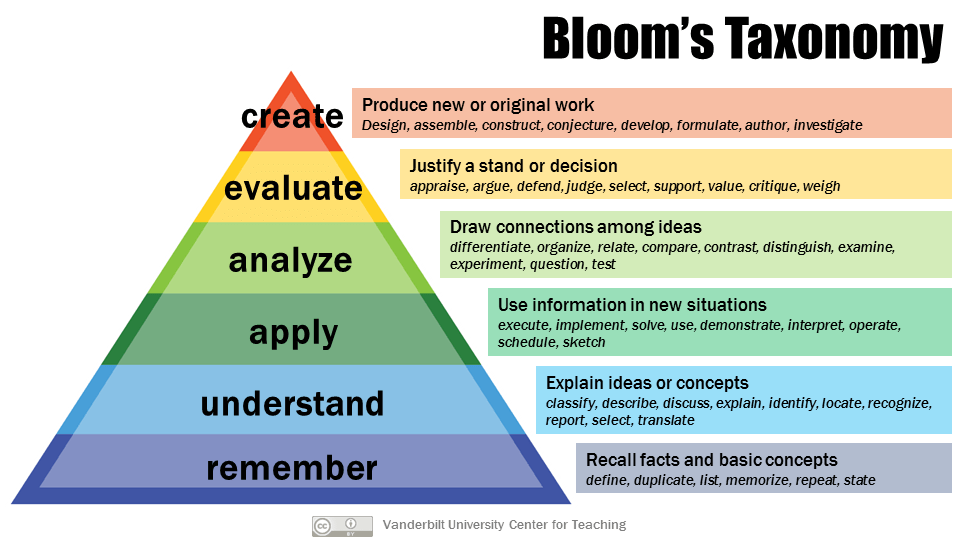
This is Bloom’s Taxonomy. The three processes on the bottom are considered low-order thinking skills:
- Remember
- Understand
- Apply
Conversely, the three processes on the top are considered high-order thinking skills:
- Analyze
- Evaluate
- Create
I know what you must be thinking. “If analyzing, evaluating, and creating are the high-order thinking skills, forget the low-order thinking skills! We don’t need them.”
But all are actually necessary for full development of comprehension. Let’s talk through each of these skills, from lowest level to highest, with some examples. Why is each step crucial, and why should none get overlooked? It’s all a part of this article.
1. Remember
To remember, according to the Bloom’s Taxonomy, means to be able to restate information, even when you have no idea what it means.
Example: Imagine a young toddler. She’s been speaking for a little bit, but she can only throw out a few random phrases.
When you start teaching her how to count, she repeats the numbers back at you, but has no clue what on earth you could possibly mean by those funny sounds you’re articulating. She just want to copy you. So, she repeats the list of numbers back, “1, 2, 3, 4, 5, 6, 7, 8, 9, 10!”
But as I stated before, she really doesn’t have any idea what it means yet.
Likewise, when we learn something new, chances are we don’t fully understand yet, but we could tell you the name of whatever it is we learned about.
Remembering is definitely a good place to start, because if we can recall the information, we’ll eventually begin to understand it.
2. Understand
When a student uses this skill, they are able to recall information told to them and know what it means.
Example: The toddler is getting better with words, and has begun to actually count her fingers, following the examples of her parents. No longer is “1, 2, 3…” just a bunch of sounds. Now, she knows that counting is a way to tell how many fingers she (or one of her parents) is holding up.
However, understanding has its limitations, too. So far, the toddler only knows how to apply counting to situations she’s been specifically shown.
Likewise, when we are first taught a concept, it’s hard to use it outside of what we’ve been taught, until we understand the concept so well that we begin to apply it to new situations.
3. Apply
Now that a student has learned the information, and can use it in some limited settings, the next level up would naturally be to use that knowledge in unknown settings.
Example: The toddler begins to realize that fingers aren’t the only thing that can be counted, and suddenly, there’s no stopping her—she’s counting her toes, grapes on a vine, crayons in her pencil box, and cracks on the sidewalk.
She took the knowledge that she could count her fingers and applied it to the world around her, without being told by anyone that you can count grapes, toes, crayons, or cracks on a sidewalk. Now she knows how to count objects, no matter what or where she’s counting.
Similarly, we begin to feel so confident with a concept that we begin drawing more and more connections between the mundane concept we’ve been taught and the real world.
(My biggest one was when I realized that the A = Pe^rt equation I’d been taught in pre-calc was actually a good way to handle compounding interest. But that was a whole two years later…)
However, this is only the end of the beginning steps. What we do after this knowledge is where the good stuff happens!
4. Analyze
Rebellion takes hold, and it’s no longer about amassing data or learning from a teacher. No. This is where the learner gets their hands dirty, makes mistakes, and compares different choices.
Example: The child starts asking, “What are the different ways to count a large number of objects?” Instead of counting by ones, she starts experimenting by counting by twos, five, tens, etc.
Teachers want to cultivate this type of high-order thinking in students, so they tell students there are no wrong answers:
- Compare and contrast these characters
- Make a T-chart about such-and-such topic
- What are some different ways you might be able to solve this problem?
Students are sometimes taken aback when they’re told to figure something out, without being able to ask, “What’s really the right answer?” They are so used to the teacher just giving them this information, that it can really stun them. Encourage participation and effort, and don’t reveal the answer.
Analysis is just the beginning to a more complete understanding, after all.
5. Evaluate
Take what you know now about analysis, with all its comparing and contrasting and experimenting, and then add these two things:
- Making a final decision
- Backing your decision up with reasons
Example: The child is still thinking about counting those large groups of objects. Now that she’s experimented with counting by twos, fives, and tens, she decides that if she has a really large group of objects, she’ll count by tens to make it easier. Anything left over will be counted by ones.
She decides that this is the easiest way to go because figuring out hundreds (if there are any) will be so easy because she counted by tens.
In a classroom, though, this can get tricky, because you know all your students won’t have the same opinion. You’ll want them to argue, but in a friendly, debate kind of way.
For example, I recently participated in a science-meets-Egyptian unit, where students were encouraged to use what they knew about table salt, Epsom salt, and baking soda to predict which one would preserve an apple slice best if left for a whole week.
Even though the teacher knew the answer, because she’d run this particular experiment a dozen times before, she gave the students no hints. They were on their own! They had to compare and contrast the properties of each substance and come to a decision on their own.
The teacher can give no input as to who is right or wrong at this point, because the students need to defend their own decisions, based on how they evaluated the arguments, and not just based on the idea, “because the teacher said so.”
This can seem scary, because we either succeed or fail by our own power. But MAN, is that effective growth or what?
6. Create
After all the hard work of the other five steps, the last one pushes students to always contribute something more. They take everything they’ve learned, and then they create something new using those concepts.
Example: The child who’s counting large numbers of a certain object decides there must be an easier way. She decides to invent a container that will only hold ten of the object she’s counting. That way, she only needs to count how many times she’s filled the container, then multiply that by ten (or if she doesn’t understand multiplication yet, just add a zero to the end like her parents taught her when they saw her grouping by ten).
After studying membranes last week, I had the students design and create one of their own.
The requirement for the membrane? It had to let up to 1/4 cup drip slowly through it over a 24-hour period. They were allowed to use any of the materials we had: sponges, tin foil, coffee filters, felt, cheesecloth, tape, etc.
It was quite the learning experience, and, of course, it was super fun. It both cemented and expanded their learning.
The Reality
It’s difficult for teachers to dedicate the time, resources, and lack of noise control that comes with creativity. And there are often so many concepts assigned to each grade that a year couldn’t possibly be enough time to teach them all, let alone get them to be creative each time.
But without creativity, the whole goal of the education system then becomes to produce identically knowledgeable people, without regard to the fact that the world needs diversely knowledgeable people.
Creating allows people to break from the standard and show a piece of themselves. It helps them have a self-realization experience.
That just wouldn’t be possible if every student was told exactly what to do, how to do it, and when to turn it in, all the time.
The Next Step
Make creativity a priority, for yourself. You know the standard of teaching. You now have to surpass your knowledge, understanding, and applications of teaching, and begin analyzing, evaluating, and creating new ways to teach.
This isn’t something that could be handed to you in a blog post. It’s time to put ourselves out there, and leave what is known for something that could be better.
Comment Below!
- What ideas do you have for incorporating creativity more in classrooms?
- What is your belief about failure and creativity?
Like what you’re reading? Get new content delivered straight to your inbox!
 Onward! Japanward!